Thursday, 7 March 2013

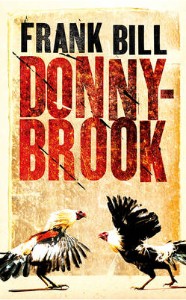
One Man's Opinion: DONNYBROOK by FRANK BILL


A little appetiser before the main course is the news that Mr Suit is free today and tomorrow.  It's a crime romp that's aimed at being a fun read and so far it's been received really well.  You can find it at Amazon in the UK and the US.

Truth be told, Mr Suit might be a fantastic short read, but it doesn't come close to the meat and potatoes provided by Frank Bill.  Here are my thoughts on Donnybrook.  My Frank assessment:
 
I received my copy of Donnybrook as an advanced review copy from William Heinemann and was very excited to find it in the post on the day it arrived. 

My excitement was based upon my love of Frank Bill’s collection ‘Crimes In Southern Indiana’ and other stories of his that are peppered around the internet and a range of highly-regarded anthologies.

I had a strong sense about the world I’d be entering – something strong and dark and gritty – but was unsure of the author’s ability to complete a novel with the immense talent he shows in his short work.

I needn’t have worried.  Mr Bill has ticked all of my boxes and, in this story, created a few more that weren’t there before.

It opens with a storm of violence.  There’s a robbery and a couple of murders and a sense of mayhem.

From there the various characters drift apart, but they’re all destined to come together at the Donnybrook, a ‘last man standing’ bare-knuckle fight that takes place over a couple of days in Orange County.

The various strands are all wonderfully handled. 

There’s the cop hunting both robbers and killers alike; there are the makers and dealers of crystal meth; there’s a martial arts master; an entrant to the fighting contest whose focus is the huge cash prize; a man blessed with visions of the future; and a host of everyday characters who are all strongly written and play their parts with honesty.

The prose is extremely tight (he doesn’t waste words, he writes them) from start to finish and this adds to the powerful, earthy sense that the book portrays.  This is particularly true of the dialogue, which is wonderfully sparse at times.

A large amount of the book describes episodes of violence.  It’s the kind of violence I like to read and feels like it’s written by someone who knows about it from first-hand experience.  The sense of pain and brutality is very real, yet it is also plain in its construction.  Among the things that makes the action such a pleasure to read is the sense of siding with one brawler or another when it takes place; the author has created the characters that are rotten to different degrees of putrefaction, but they all share human traits and some feel more human than others.   Throw in a broad range of motivations and the mix is nigh on perfect.

As well as the hard core elements of the narrative, there are also moments of great subtlety.  Lines and situations can be packed with a sense of beauty, humour and poetry that act as a great contrast to the other textures, even when they relate to tragedy.  There’s a real pathos here and these moments add a full range of shades to the blacks and whites of the book.

Donnybrook is a male dominated novel.  It’s hard-hitting and punchy and is a really fast-action read.  My adrenaline was up throughout and my admiration remains undiminished.

Frank Bill is one of those writers who should be read and I intend to follow him wherever his work takes him.


Donnybrook is available in the UK and US as Kindle as well as in paperback and hardback copy.  What are you waiting for?


Wednesday, 6 March 2013

Dancing with Myself: WARREN MOORE interviews WARREN MOORE


Q: Good Lord, you’re enormous, aren’t you?

A: Yes. I’m 6’4”, and heavy for anyone who isn’t nine feet tall. When other writers approach me too closely, they fall into long, elliptical orbits. When other medievalists approach me too closely, they fall into perfectly circular orbits with epicycles. I once said I was large enough to blot out the sun. Another guy said I was large enough to blot out the Father and Holy Ghost as well – and since he was a minister, I guess he’d know. So, yes. Big. On the upside, I’m grateful my mom smoked two packs of Marlboro Reds a day when she was pregnant with me, stunting my physical and intellectual growth. As it is, I’m mammoth and earned a Ph.D. in medieval literature. Had she not smoked, I’d be 22’ 9” and able to split atoms with a single thought. Who needs that kind of pressure?

Q: So tell us about Broken Glass Waltzes.

A:  Cincinnati, somewhere around 1990. Kenny Rockford plays drums in a heavy metal cover band on the bar circuit in this part of the Midwest. He wants more, but he’s getting paid and getting laid, so inertia is strong. One night after a show, he brings the wrong girl home. A very wrong girl. Hilarity ensues, and by hilarity I mean sex, violence, sexual violence, loud music, and all the other things that make life worthwhile. Also, motorcycles and Cincinnati-style chili.

Q: How long have you been writing?

A: Since before I could write. There’s an audiotape my father made when I was about three. He’s chatting with me a bit, and I tell him I made up a song, which I then sing. It’s about spiders and how people love to get into their warm webs. When I finish, Dad says, approvingly, “That’s pretty weird, kid.” And in a way, I’m still writing that song, except the webs are different, and the spiders only have two legs.

I started getting paid for my writing when I was in high school – I wrote love poems for folks who weren’t good at it. The Cyrano thing. I also wrote ad copy for pay around that time – a 25-part public-service campaign on historical figures. I wrote a humor piece (called “Rock and Roll Girls (and Other Horror Stories)”) for a college lit mag as an undergrad, and I started writing contemporary/urban fantasy for a semiprozine called Low Orbit when I was working on my M.A. at the U of Kentucky. Around that time, I started writing Broken Glass Waltzes – that’s right; it wasn’t a period piece when I started it. After that, a six-year stretch as a magazine editor and free-lance music critic in Cincinnati, and then I headed back toward fiction writing when I went to Ball State U for the doctorate, and since then during my time here at Newberry College. And of course, for most of that time, I was also writing songs for the bands I was in.

Q: The heavy metal thing isn’t bullshit, then?

A: Nope. I’ve been playing drums since I was a pre-teen, and spent my high school years covering stuff like Judas Priest, Sabbath, and Krokus. Later, I got heavily into Michael Schenker’s work – my first “national” publication was a review of McAuley-Schenker’s Perfect Timing. The review ran in a spinoff of CREEM, which folded without ever paying me. Welcome to rock-and-roll journalism.

I still listen to metal a fair bit – I seem to have a weakness for Doom and Stoner Metal (which is weird, because I’ve never done drugs. I don’t even drink, although I have done that before.) A lot of the more recent cookie monster stuff doesn’t do that much for me. I listen to Sleep a lot these days, along with Trouble and Masters of Reality (the band, not the Sabbath album.) And of course, there’s always something to love from Alice Cooper.

Q: Where are some other places we can find your fiction?

A:  I just had a story come out at Out of the Gutter, and I have a couple at The American Culture. With luck, there may be more before too long.

Q: Writers get rejected a lot. Do you have any good

rejection stories?

A: Well, while I was doing the M.A., I was also writing fiction, which I would send off to entirely inappropriate market s like the Atlantic and New Yorker. They, in turn, would bounce it so fast I’m pretty sure they had an editor waiting at my local post office. One afternoon I was at the University post office to collect my rejection slip, when I saw a cute young woman at the elevator. We struck up a conversation. We’ll have been married for twenty years this October. I’ll take a lot of rejections for an acceptance like that.

Q: You said you used to write SF and fantasy. How did

you get from there to crime fiction?

A: I started reading comic books shortly after I started walking, and so I grew up reading about Spider-Man, Batman, Superman, and the rest of the crew. On the one hand, that stuff is fantasy, but on the other, they’re typically fighting some kind of crime, so moving into detective fiction wasn’t a big stretch. I discovered Robert B. Parker through the Spenser: For Hire TV show, and my dad turned me on to Travis McGee and Shell Scott. Not long after that, I found a copy of Jim Thompson’s The Killer Inside Me, and that sealed the deal. I discovered I was more interested in writing “Will they get away with it”s instead of whodunits. A lot of my scholarly work has addressed the seductiveness of evil as well – my doctoral dissertation was on the Seven Deadly Sins in early English drama. Maybe I’m just morbid.

Q:  What’s your take on the rise of e-publishing and

self-publishing?

A: Since I’ve been doing music for a long while, and was in college through a lot of the 80s and 90s, I got used to the indie-label and DIY  approach to rock and roll. In a lot of respects, I see what’s happening in publishing as being pretty similar. If you couldn’t find the music you wanted at the record store, then you started your own label. If you love a kind of fiction, poetry, or whatever, you launch a small press, because technology has made the process much more affordable. The upside is that this creates many more opportunities for people to get their work out there. The downside is that not all the work that gets out there is ready yet, or at all, and with so many small voices out there and an absence of promotional budgets, it’s easy to get lost in the shuffle and white noise. It’s still brutal to try to make a living doing music or fiction – there’s a reason I’m an English professor, after all. But anything that gives people a chance to be heard – even if it’s only by a few folks, even if you wind up a weekend warrior – I’m for, and I think a lot of writers probably feel that way, too. Sure, we think it would be great to make monster bucks with this stuff, and my main man Samuel Johnson famously said that no man but a blockhead ever wrote anything except for money. But when it gets down to it, you write because you think you have something worth saying, because you want somebody – anybody – to listen. The new technology gives our words a non-zero chance of being heard. That’s good. And remember – Samuel Johnson self-published as well.

Q: What do you look for in the stuff you read?

A: I want to hear a voice. If I can hear a voice, it means I’m going to care about the character, and that means I’m going to keep reading until I stop caring. I want things to happen. I want you to make me smile, laugh, shake my head, shudder, choke up – have some reaction other than “Oh, look, another novel/short/whatever.” If you can dazzle me with your gorgeous prose style, great, but if there isn’t a voice or passion there, then the technique doesn’t matter. A guitarist friend of mine was talking about Yngwie Malmsteen once. He said, “The first time you hear an Yngwie solo, you go ‘Wow!’ Then you hear the next solo, and you go, ‘Well, wow again… I guess.’” A shredding solo or brilliantly turned phrase will get my attention, but in the long run, it has to advance the song or the story. That’s why I’d rather listen to Ringo than to Mike Portnoy, and it’s why I’d rather read Louis L’Amour than Don DeLillo. (And besides, both Ringo and L’Amour have more chops than they get credit for.)

Q: Is there anything in the pipeline?

A: That’s a rather personal – oh! You mean writing. I hope so. I’m about 10,000 words into another story, under the working title A Safe Distance. We’ll see how it goes. And thanks for lending me this soapbox.
 
Broken Glass Waltzes is published by Snubnose Press and is available from Amazon at US and UK.
 
As for the interview, it's a cracker and I think that's the finest rejection story I've ever come across.  If you have one that comes close, let me know.
Sunday, 3 March 2013

Indie Scene Magazine


Here's a pretty cool magazine.

As might be the case with a work involving a fairly diverse group of people, you may not be interested in every piece.

If you're interested in book recommendations, interviews, tips for writers (indie or with publishers, I'd say) and tips for readers, this may well be for you.

The best part of all is that it's free, so you can get to try it for nothing.

Why not give it a go.  If it's not for you, you'll not have wasted any more than a little time.

Check it out at Indie Scene Magazine.

Saturday, 2 March 2013

In The Post This Week

It's been a great couple of weeks for me in terms of the things that have slipped into my email or through my letterbox.

First off was Frank Bill's Donnybrook.  I've read this one and love it - it's a really powerful story that should be added to your list of to reads.  It's available from 5th March in the States and from 7th March in the UK.


Next, Blubber Island.  I'm intrigued by this one as it could be anything from the description.  The only way I'll find out is to read it and I'll let you know when I have done so.

Thanks to Ishmael Galvan for that one.


 I'm delighted to see that Dawn Reeves has released her debut novel and more delighted to see it this morning in the flesh.  It's set in the midlands and the book has a lovely feel to it.  Hard Change is where it's at and it was launched in London last night.  It's available in the UK and US as Kindle and paperback.


Then came Craig Wallwork's The Sound Of Loneliness.  I know Craig is a talented writer, so this has got me on pins. 


In the inbox, I was very pleased to get Kindle files of Beat To A Pulp Hardboiled 2.


and the autobiography of that lovely bear of a man, Josh Stallings, entitled All The Wild Children.
 
I'm also pleased to see that Blasted Heath continue their high-quality output with the latest Ray Banks, Inside Straight.  Way to go Heathens.
 
Thanks to all for sending and I hope to get to read and review in the next month or so.
 
Happy hunting. 


Saturday, 23 February 2013

One Man's Opinion: NEDS by PETER MULLAN


Neds – Non Educate Delinquents.

This is a film that looks at a sub-culture that’s rooted in the 1970s and onwards, a sub-culture that reflects in some ways the experiences of the down-trodden youth of poor backgrounds the world over from a much broader spectrum of time.

The main character, John McGill, is a young lad who has an auntie who is a journalist in New York and a father who is an abusive, violent drunk. 

John’s a bright lad with good prospects at school, or at least he would have if his older brother hadn’t already queered his pitch.  It takes a while for him to show his potential and he manages to stay on the rails for his first 3 years in secondary school.

There’s a certain inevitability about the beginning of his decline.  He’s rejected by a middle class family with whom he makes a link and from there gets mixed up with a bad crowd who act like a plughole to his swirling water.

Time’s spent hanging about doing no good.  A little fighting.  Some snogging.  Low level crime.  Vandalism… you can imagine the kind of thing.

The violence escalates and John’s delicately balances psyche is toppled after a series of events that push him over the edge and he’s forced to leave home and shack up in a boiler in one of the local tower-blocks.

There are many things to like about this film.

The setting is wonderfully done.  I loved the feel of the seventies and felt that this was about as close to my memory of the time as any modern attempt to recreate the period.  It may have used some obvious tricks to help create this illusion, but I reckon it’s only the obvious that would work to such good effect.

The violence is tremendously handled.  I wouldn’t usually comment on such things, but it really works.  There’s a matter-of-fact view of some of it (you’re involved in a big fight or watching one, it doesn’t have the frills that you often see on the movie screen, and it’s all hard blows and over in a blur more often than not).   There are a few rumbles between rival gangs.  There’s a humour to some of it that helps and there’s the down-right brutal cold feel of serious events.   Favourite of mine was a short scene where a young lad’s being tortured.  I don’t want to spoil it, but can’t help myself.  A rope has 2 bottles attached to each end and is swung around the victims neck.  The rope tightens and eventually the bottles clatter in to the victim’s head.  And they do it again.  It shouldn’t be funny, but for me it was a comedy moment.

There’s a great sense of place that is created by some fine filming and great acting.  There are some talented characters here and I think we’ll see more of them in the future.

John McGill reminded me of Ray Winstone in Scum.  Hard and deadpan and slightly deranged and with a very strong presence that makes his descent easily believable.

The plot itself works well.  It does it by the numbers at some points and that’s a shame, but mostly I enjoyed the steps from A to Z.

A couple of scenes stood out for me as ones I’d have cut out if I had any sway over it.  One in particular that follows a bout of glue sniffing just took things too far for me. 

All in all, I’d recommend this with some confidence.  Lots to like and plenty of entertainment for your buck.

I’d suggest a double bill with That Sinking Feeling for a compare and contrast session afterwards.

Go and have fun.


Wednesday, 20 February 2013

Sleeps With The Fishes


It's been a busy time of late and I've not been online as much as I'd like to have been.

The good news (for me at any rate) is that I've just completed a novella set in my home town.  Finishing a piece can be such a relief and I'm delighted to have made it to the top of this one.  As many of you will know, however, getting to the top is only a breather before tackling the descent into editing et al which is where the harder graft can be.

It's completely different from my general, except that it's similar in style to other pieces.  My intention was to write something for a young adult/adult audience who can stretch to mild sci-fi.  In the end, my own jury's out as to whether my effort's been worthwhile, but there's something in there I like, so fingers crossed.

Meanwhile, Mr Suit, that sharp little novella of mine, has been reviewed over at Crimesquad.  I'm very pleased to see their opinion shared - many thanks to GS.

Here's a snippet:

'The prose is tight rope taut and the plotting first class...All in all ‘Mr Suit’ is a tense and thrilling novella which deserves a place on your bookshelf.'

I'm also here to let you know that I have a giveaway today.  It's called Sleeps With The Fishes and it's a short story in the region of 5k in the wordcount department.  For me it's a piece of dystopian fiction that reminds the reader to maintain a sense of the political world in order to avoid the overly sinister movements (however crazy they may seem) climbing to power. It's available in the US and the UK for free over the next few days.  After that it'll be back to the 75p/99c mark - which is about what it's worth in my opinion.

There's been one review so far by a Top 500 Amazon reviewer in the UK:

"This short story is both atmospheric and claustrophobic. It features a man who has spent 18 months hiding in a basement from the authorities because of an accident of birth. A new government has decreed that people with the wrong birthsigns are to be done away with. I love a story that makes me think, 'What if..?' If it were proved that more criminals had one birth sign than another, would that be a reason for condemning all people born at that time of year? Of course not, but could a cunning politician or two make people believe it?

Nigel Bird's writing is conversational in this short story, but perhaps because of that, it is very direct. The story portrays an uneasy future which made me shudder. We often think, 'That couldn't happen' but we've been wrong before. A very good read."

Another free book worth catching today is by Patrick Quinlan and it's called The Hit (US - UK).  Check it out.

Also to be flagged, there's a new paperback version of the All Due Respect anthology available now and you can pick it up at Amazon via the US or UK links here.  You buy it, you won't regret it for a moment, guaranteed.  I'm very proud to have been included in there.

My muddy paws stretched over to Brit Grit Alley last week to talk about Ripper Street.  It's a piece designed to gather discussion, so if you have an opinion it would great if you'd share it.

I have also been fortunate enough to have been sent an advance copy of Donnybrook by the sublime Frank Bill.  Can't wait to dig in to that one - it'll be available very soon, folks.  Keep those eyes open.

And welcome to the spring.  There are snowdrops in my garden.  Hi snowdrops.

Sunday, 3 February 2013

Dancing With Myself: JIM WINTER interviews JIM WINTER


YOU’RE BACK THIS TIME WITH A COLLECTION. WHY NOW?

I’ve wanted to put the Keplers together for a while now. Since the third Kepler novel still needs work, I thought this was an opportune time to put all those shorts together.

WHAT WAS THE FIRST STORY?

The first written was “Race Card,” which shows in the rather large cast of characters and complex plot. The first published was “A Walk in the Rain,” which went to Plots With Guns the same week it was written.

DO YOU HAVE A PERSONAL FAVORITE?

I’m partial to both “Roofies” and “Full Moon Boogie.” Both have rather strong female characters. One is a survivor, turning a rough life to her advantage. The other is someone who long ago decided to live life on her own terms after trying to live up to everyone else’s.

WHAT WAS THE STRANGEST ONE TO YOU WHEN YOU FINISHED IT?

“Wring That Neck.” I never really saw Nick functioning in a rural setting before. It was supposed to be something of a parody.

IS THERE ONE YOU WORRIED MIGHT NOT WORK?

“Flight of the Rat” gave me pause. It went to Judas, whose editor actually saw the plane hit the Pentagon and later learned a friend of his was on that flight. That was written about 2003, and even then, there was a “Too soon” cloud that hung over writing it. I think any other editor would have taken a pass on it.

WILL THERE BE MORE NICK KEPLER?

Bad Religion, the third novel, is in the can, in need of a couple more passes. There’s also a novella called Gyspsy’s Kiss, where Gypsy from “Roofies” decides she wants to leave the sex trade once and for all, but only after she has one last client. I had a sequel to Bad Religion outlined, but haven’t decided if I’ll write it or not.

WHY NOT?

I’m currently rewriting Holland Bay, which has become that cliché novel a writer is always working on but never finishing. I decided last year to put up or shut up with that one.

HOW ABOUT ANOTHER COLLECTION?

I do plan to put the non-Kepler shorts together in a collection called The Compleat Winter, probably late this year or in early 2014.

Jim Winter shows up at work every morning and spends about two hours on Tumbler pretending to write code. He lives in Cincinnati with his wife and stepson.