Thursday, 11 February 2016
One Man's Opinion: BLAZE by STEPHEN KING writing as RICHARD BACHMAN
Clayton Blaisdell (Blaze US) is a big guy. There's a dent in his head. He's the kind of person you're going to remember if he commits a crime, so it's even more important than ever that he takes precautions before he goes to work. The only problem he has is that his brain capacity has been severely hampered ever since his father beat him to within an inch of his life many years earlier. Because of this, he has to rely upon his old friend George to keep him right. This would be fine if George weren't dead and if his advice didn't come in random bursts.
When we meet Blaze, he's down on his luck. The only way he can think of to get back onto his feet is to carry out the one big job that George had planned when he was still alive, the kidnapping of a baby from an extremely wealthy family. It's a pretty good plan at that, except that Blaze is out of cash and has made no preparations for the welcoming of a new baby into his life.
The story splits into two parts at a fairly early point in the book.
The first strand follows the impending kidnapping and the consequences of the attempt. It's a nicely played out tale that balances tension and action really well. It also carries a warm strand of humour that is very pleasing and had me laughing out loud on several occasions.
The second part deals with Blaze's life in the institution in which he was brought up. This was really important to the book as it really alters the perspective on Blaze entirely. Instead of a loathsome kidnapper, he becomes a sympathetic character. The more I got to know him, the more I loved the guy. His heart's as big as his fist and circumstances have thwarted his bids for happiness at every turn. There's less humour here. The tones are somehow duller, yet the power they carry is all the more enhanced because of that.
I'd compare this to another Stephen King novel, but I realised when I took this on that this is the first I've ever read (unless my memory is even worse than I think it is). What it did for me was to suggest that I'd love to read more. I also found myself rooting around on my shelves (unsuccessfully, I'm afraid) for my copy of Of Mice And Men.
There is an introduction by Mr King, by the way. I started it, but abandoned it half-way through to get to the main course. I'm sure it's really interesting to his fans; to me his story did the talking that was necessary.
Blaze was a terrific read and is the kind of story I'd recommend for a long commute - flowing material and plenty of hooks to keep you going.
Wednesday, 10 February 2016
Dancing With Myself: MATH BIRD (no relation) interviews MATH BIRD (no relation)
I’d
like to welcome Math Bird, great penname by the way . . . Why are you looking
at me like that? It’s not your real name, right?
Unfortunately, yes. My name is Matthew,
but in parts of Wales, it’s shortened to Math, and that’s what I’ve always been
called (I’m sure I’ve been called other things, but you know what I mean).
And
you like that name?
Yes. It has grown on me. Granted, having
the surname BIRD and growing up on a large Welsh council estate in the 70s had
its challenges. But it has stood me in good stead.
Hmm,
interesting, and there’s me thinking you were just trying to give yourself a
weird name to stand out from other writers and be pretentious.
Look, any more comments like that and
I’m walking out.
Ok,
sorry, so you mentioned you grew up in Wales, which part?
In northeast Wales, by the Dee estuary,
it’s near the English border.
Yes,
that’s right. It features a lot in your stories.
Yes, a beautiful, ugly place, part
Welsh, part English, neither fish nor fowl so to speak. I write about it a lot.
Culturally, it’s a hybrid. When people think of Wales, they tend to think of Dylan Thomas, Welsh Male voice choirs and How
Green Was My Valley. Northeast Wales is nothing like that. Don’t get me
wrong it’s picturesque and has plenty of sheep. But it has never sat
comfortably with common notions of Welsh identity.
And
you try to address that?
In my own little way, yes.
Through
crime and noir fiction?
Yes. For me, story is the most important
thing. But through that, I try to blend in some of the cultural and social
themes that interest me.
So
why crime and noir fiction, has the genre been a big influence on you?
Yes and No.
TV-wise, I grew up watching Frank Marker’s Public
Eye, and Callan, and loved films
such as Get Carter, and The Long Good Friday. But when it came
to reading, I loved and tried to copy (very badly may I add) classic Welsh
writers, such as Gwyn Jones, Rhys Davies and Caradoc Evans. Especially Gwyn
Jones, some of his darker stories such as The
Pit, The Green Island and the
brilliant Brute Creation are noir
without the title. So I started writing noir without actually realising it and
as I discovered Jim Thompson and James M Cain added more
crime elements into it. Then, when I started reading brilliant magazines such
as All Due Respect, Pulp Modern, Shotgun
Honey, ThugLit, Plots with Guns, Plan B Magazine etc., I thought this reads
like the stuff I write.
And you’ve placed stories in some of these
magazines?
Yes, I’ve been
very fortunate to do that. My story Histories
of the Dead was written especially for All Due Respect and my story the Devilfish was written especially for
Pulp Modern, and luckily, they were both picked. I love the fact that among
stories set in Texas, Chicago, Seattle, there are crime stories set in
Northeast Wales, and I love and respect magazines such as ADR, Pulp Modern and
PWG etc., for taking that chance.
But your latest novella, the psychological noir
thriller The Whistling Sands (US), isn’t
set in northeast Wales; it is set in West Wales, right?
Yes, but the
main character, Ned Flynn is from northeast Wales, and he has all the baggage
that comes with that.
Sounds interesting, tell us more.
Well, without
giving too much away. The story is in the tradition of Jim Thompson and James M
Cain, with a modern take. Fundamentally, it’s about obsessions, greed, lust and
the stories we tell ourselves, and what we want to believe. It has a lot of
noir elements, losers, femme fatales, murder, and good intentions gone wrong
and spiralling out of control. And the ending, in my opinion, pulls no punches.
Sounds great, so what’s next?
A new Ned Flynn
novella at some point, but I’m currently working on a new novel called Welcome to Holy Hell. It’s set in the 70s,
a cross between Barry Hines’s KES and
Thompson’s The Getaway . . . That’s about it really, unless there are any
more questions.
Yes, a little bird told me (pardon the pun), that
your PhD thesis was on The Regional Welsh Thriller.
So?
That’s a bit useless isn’t it?
How do you mean?
Well, if you were on an airplane and someone asked
is there a doctor on board and you stood up and said, “Well, yes, but I can’t offer any medical assistance, all I can do is
tell them about a few obscure Welsh writers.”
Right, that was
your last chance. I’m stopping this interview now. There’s a dark side to you.
I’d have been better off interviewing myself.
Thursday, 4 February 2016
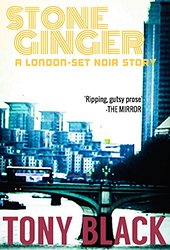
One Man's Opinion: STONE GINGER by TONY BLACK
It wasn't that long ago when the Kindle and ebook revolution threw up the opportunity to writers to publish single short stories. Go back five years and there were plenty of them to be had. It was a treat and great to see work coming out in a range of shapes and sizes. For 75p or 99c, you could get a quality short read. To some that might sound a lot, but in terms of value that seems pretty good to me.
Things have changed a little. Market forces have done what they usually do and ironed the world out. Flattened it in some way and taken away some of the edge. And it's not something I have a big problem with, it just seems like a shame, that's all.
In a world where people are able to get hold of great novels for 99p or less (even for free, of course) it stands to reason that a short story for around the £1 mark isn't going to seem like value. I'd argue that, given the single short story can't be available any more cheaply, it's the longer work that should be priced higher to give those little guys a chance.
To offer comparison, surely a tightly written story is worth about the same as a couple of tins of beans or half a mug of coffee in a cafe (and less than half if you're going for your Starbucks take-out).
This isn't a moan. It's simply an observation.
The reason it came to mind was Tony Black's decision to release a short story called Stone Ginger (US). The actual title is Stone Ginger: a short noir story, which is great because there can be no complaints from readers that there aren't enough words. It's a piece that I really enjoyed and feel is well worth that lowly price of entry.
The only problem I have with the length is that it doesn't leave a lot of room to work with in terms of a review. The blurb reads:
'When Charlie 'Minty' Lamb meets the gorgeous Ginger down the local boozer he thinks all his Christmases have come at once. Even the boys from the back-shift can't believe his luck, that is until one or two of them start to notice that Ginger might be something other than she appears. Soon Minty's questioning himself, and everyone else with good reason. A fast-paced noir short for fans of the classic London crime caper.'
That's a pretty good summary.
I'd like to add that the story-telling voice is strong and that the twist isn't the one I was expecting. There's a good line in humour and it's oozing with flavour. There's a lot packed in here and it's well worth taking the time to check it out.
If you feel that the price-tag is too big for your pocket and you're a Kindle-Unlimited subscriber, you can get this one for free, so what are you waiting for?
Friday, 22 January 2016
One Man's Opinion: THE JUMP by DOUG JOHNSTONE
At the opening of the story, Ellie is struggling to cope
with life. Her son, Logan, killed himself by jumping from the Forth Road Bridge
and there’s no escaping the hurt and confusion that has brought. This early
section is a painful dissection of suicide and the after-effects of the event
on the survivors. It’s harrowing stuff. The author has clearly done his homework
and knows how to present the information in a way that is very unsettling.
On one of her obsessive forays out along the bridge to the
point where Logan jumped, Ellie encounters a young man who is contemplating
doing the same. In a tense scene, she manages to persuade him to come down. For
Ellie this is the second chance she never had with Logan. She takes Sam home
and does her best to put him back together without informing her husband Ben,
who is coping with his loss in a very different way to her.
As she gets to know Sam, she uncovers a dark background behind
his misery. It involves the stabbing of his policeman father and a nightmare of
a family situation. Suffice it to say that this is also disturbing and distressing
and, once again, Johnstone pulls no punches in his delivery.
In order to protect Sam, Ellie has to take many risks. She’s
prepared to push the boat out (sometimes literally) beyond the boundaries of
normal human behaviour.
The Jump is often gripping and moves with the energy of a
good thriller. Whilst shifting with the action, the psychological scars and the
open wounds are explored and offer an interesting foil to the adventure. The
balances and interplay here is interesting and Johnstone does a pretty good job
of holding the internal and external narratives together.
As well as deserving credit for producing another engaging
read, the author should also be applauded for his choice of material. Suicide
is not something that is openly discussed. It might be that because of this
book there’s a shift from this position. Here’s hoping.
Wednesday, 20 January 2016
One Man's Opinion: OUR SOULS AT NIGHT by KENT HARUF
Louis Waters is an elderly widower with a routine of his own to keep him going. Life is a stagnant pool with the occasional splash. Death is waiting around the corner and it doesn't really matter when it arrives. Until, that is, his old neighbour pops round with a proposal that will change everything.
Addie Moore is also old and living by herself. Her loneliness has become too much to bear and she's come up with a possible solution: asking Louis if he'll come over to spend nights with her so that they can talk. There's no sex on the agenda, just companionship.
Louis can't resist and decides to give the proposed arrangement a try.
What unfolds from there is a wonderful story that overlaps the past and present in a superb balance. Addie and Louis reflect upon their lives. Neither's journey has been straightforward and each have had plenty of time to allow emotions to settle since the major incidents of their time.
Their new arrangement soon sets tongues wagging and word gets out to their children. The range of reactions of the people in their small town and the way the couple cope with them offer some wonderful vignettes and tell huge tales in small packages.
Life becomes more complicated and far richer when Addie's grandson comes to stay. The early complications of the transition are dealt with using tenderness and wisdom and a series of adventures follows in which the three bind tightly together.
The whole read has a magical feel to it. Part of that magic lies in the fingers of the writer. Using simple strands of conversation and events, he has woven an elaborate and moving tapestry. There's an effortless energy to the tale and yet it carries an ever-present tension to add a gentle momentum throughout.
I found the story to be strangely soothing. It's life-affirming without being manipulative. The emotions that run through it are strong and hit home. I loved spending time with Louis and Addie and hope that my twilight years can be half as warm, complicated and fulfilling as theirs.
Our Souls At Night (US) is a special book, one that's going to stick around with me for a good while. Treat yourself.
Thursday, 14 January 2016
One Man's Opinion: FAT CITY by LEONARD GARDNER
‘At one time he had believed
the nineteen-fifties would bring him to greatness. Now they were almost at an
end and he was through.’
Fat
City (US)
centres upon the lives of a stable of boxers and their coaches. In truth, it’s
not much of a stable. There are has-beens and hangers-on and
never-had-a-hope-in-hell characters who sometimes turn up to train and
sometimes don’t.
Things look to be on the upturn when Tully discovers a new
talent in the form of the young Ernie Munger, so much so that Tully begins to
think that a return to the ring might not be beyond him. All he really needs is
to get over his divorce, kick the booze and get himself in condition and
anything might be possible.
The tales of the history of the training and their bouts is
compelling. Even more powerful is the examination of their personal battles. Each
of their lives a struggle against demons without and within. Their worlds are
tough. Money is tight. Women bring pleasure and pain in equal measure. The
mundane is everywhere and the only hope of escape seems to be to put on the
gloves and either take or dish out a beating.
Some of my favourite scenes revolve around the seasonal work
offered on local farms. These are handled superbly and highlight the depth of
the desperation.
‘And so Tully,
relating the story of his marriage, crawled through the afternoon, separating
the nuts from clods until all the nuts were the same hated one thrown forever
into the bucket.’
I love this sentence. It resonates with me as I’m sure it
would with many. That sense of the pointlessness of the daily grind. The repetition
week after week. The harnesses that have to be endured. Working is tough.
Surviving can feel hard. Life could always be better. Even for the lucky ones.
This is a fantastic read. The prose is tight and powerful. The
cycles of hope and despair are compelling and the desire to root for the
characters in whatever they do is strong.
Read it.
Wednesday, 6 January 2016
One Man's Opinion: A COLD DEATH IN AMSTERDAM by ANJA DE JAGER
It’s been a while since I read my last Dutch-set crime
novel, which most likely would have been an old Van der Valk in the form of a
tattered old Penguin paperback (note to self, dust off the old Nicholas
Freelings). My visit this time came courtesy of a new detective on
the scene, a cold case worker called Lotte Meerman. I’m very pleased to have made her
acquaintance and I hope we get to meet up again at some point in the future.
In
A Cold Death In Amsterdam (US)
Meerman has become something of a celebrity on account of her solving an old
investigation of a missing girl. Her growing status hasn’t done her any
favours, however. For complex and personal reasons, she is hiding the truth
about the way she came about her information. She is also haunted by
her findings as it reminds her of her own brief time as a mother.
We meet her driving through the snow in the middle of a
restless night. She stumbles into an armed robbery, the consequences of which
lead her into another murder inquiry from the past. This time, her work will be
complicated because her father worked the initial investigation and
appears to have a rather large secret to hide. It’s not long before it becomes
impossible for her to hold all the threads together and her own unravelling is
accelerated.
Her relationship with her estranged parents is explored and
tested throughout. This personal journey is very nicely handled and the
unfolding of the detail and history is nicely paced.
As the central focus of the book, she couldn’t be stronger.
The physical setting here is also pleasing. Holland offers a
great landscape that is more than just a backdrop for the story. The book also allows some insight into the internal workings of the
psyche of a particular strata of Dutch society – lurking shadows, rational
application, a sense of the desire to protect privacy and the ways lies are
told without completely destroying the truth.
If there’s a slight flaw to this one, I’d mention the
financial aspects of the new case. As the murder was related to a big
investment company this has to be dealt with, but at times its narrative
detracts from what is otherwise a steadily building tension and nicely handled
drama.
Overall, a very enjoyable read. Anja de Jager’s creation
offers fresh and fertile pastures for those looking for a new detective to
follow, especially if an interesting continental clime is appreciated.
Subscribe to:
Posts (Atom)