Friday, 12 November 2010

Dancing With Myself: CATHI UNSWORTH interviews CATHI UNSWORTH


You worked for the music papers for a long time — who were the most interesting people you met doing that?

My favourite experience of all was from 1993, learning to dance the Texas Two-step with Mark Rubin of The Bad Livers in Austin, Texas, to the sound of Dan Wasler’s Real Band of Texas. Outside of the late Hank Williams himself, there is no more spooky, plaintive sound than that man yodelling ‘The Long Black Veil’. On the same trip, Mark also introduced me to a 93-year-old bluesman called The Grey Ghost, who had actually worked the medicine shows at the turn of the century and had a pearl-handled revolver down the back of his pants that he called ‘Old Snoopy’. It really did feel like I had stepped into another world, into a Flannery O’Connor or Harry Crews book.

Flannery, Harry, ‘The Long Black Veil’ — this trip worked its way deep into your psyche, didn’t it?

It did, because it wasn’t anything like your normal music business experience, this was a link to a past that I had only read about in books or seen on the big screen, and it was a visceral moment. Harry Crews is one of my favourite authors. I came to him through Lydia Lunch, who liked him so much she had a band named after him for a while. He is a genuine outsider and a genius writer – actually much easier to read than Flannery. The thing with Harry is that it seems he’s writing magic realism but then you realise he is describing something that actually has happened to him, it’s all based on the truth. And that was the world I briefly encountered in Texas that never left me. It has parallels to my own childhood, which was mostly spent in Norfolk, the Texas of England…

All tractors, incest and one-eyed farmers, was it?

We lived in the middle of a field; our nearest neighbours were quarter of a mile away. The closest village had been infiltrated by holy rollers, people like the Southern Baptists in Harry’s A Feast of Snakes who rolled around in the aisles speaking in tongues. One of them seriously told me that he had undergone a 12-hour exorcism to remove the spirit of his favourite band, KISS, from his body. KISS, he told me, stood for Knights in Satan’s Service. There were also plenty of kids who hung around the graveyard trying to summon up the Devil via Dennis Wheatley books. Plenty of local legends about the hellhound Old Shuck and the more corporeal, but no less evil Witchfinder General, Matthew Hopkins.
My brother and I used to entertain ourselves by trying to make up stories more terrifying than those, usually while we were walking around the countryside after dark. He was better at this than I was, convincing several of the kids from the village that there was a violent apparition that haunted the lane that led to our house — it was actually our elderly neighbour out walking his dog, but more than one person ran the whole way around a 20-acre field in the dark to escape his clutches.
It’s really no wonder I turned out to be such a goth.

And no wonder small children in the street still shout ‘Cruella!’ when you walk past.

Indeed. As well as instilling in me a lifelong addiction to black eyeliner and hair dye, the music of my teenage years is probably the biggest building block of my personality. Siouxsie & Banshees, The Sisters of Mercy and Theatre of Hate/Spear of Destiny provided me with a parallel universe of mystery and glamour to escape to during the hateful years of school. When I was old enough to go to gigs and then art college, the people that I went with became lifelong friends, some of whom also went on to work very successfully in the music business. So that little patch of Norfolk soil was a fertile one for us weirdos…

And music led you to crime, too?

Yes, when Gallon Drunk made a record with Derek Raymond of I Was Dora Suarez, and I met him in the French House to do an interview and didn’t get home for another 12 hours… I only knew him for a year, all told, but he had the most profound influence on me – I can honestly say that my life would have turned out completely differently if I hadn’t have met him. A lot of people say the same thing about him. He may have written the darkest books, but he was an angel, and everyone who knew him remembers him as the focus of light and laughter in every room he entered.

You also worked for Bizarre magazine for a long time – that must have been interesting…

Working for Bizarre taught me two of the most important things. One was the way of combining the strands of all the things I love — hidden history, pop culture and the esoteric, which all meet in my books to varying degrees. Two, I ran the books pages there for three years and in that time, got to meet just about all my favourite living writers. It was one of them, Ken Bruen, who urged me to write my first book, and another one, Martyn Waites, who hooked me up with my agent. As the Deputy Editor, I was once able to commission the ex-bassist of Blondie, Gary Lachman Valentine, to write a feature on people who are born and able to fully function with no brains. No one ever believes any element of this last story, but it is all perfectly true.

And a Bizarre connection led to your own musical collaboration?

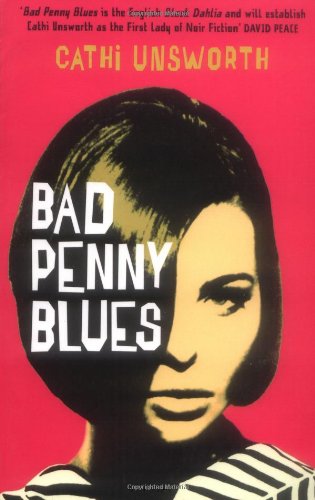
Yes, Pete Woodhead, who I met when we both worked at that place, became one of my best friends, built my website for me, and worked on a ‘soundtrack’ for parts of my novel Bad Penny Blues. Pete has his own home studio and we made all the special effects for the soundtracks ourselves. He recorded me reading what we both thought were the most potent parts of the novels — the last words of each of the women who are murdered. Then he built the music around it, and we put it out on my website for anyone who wants to download for free (www.cathiunsworth.co.uk).
It caught the ear of a Norwegian radio journalist, Leif Ekle, who was also a fan of Derek Raymond and the Gallon Drunk Dora Suarez album. Leif invited us over to Oslo to perform these pieces live, and kick off an initiative for writers there to create their own spoken word/soundtracks. One of my old Sounds buddies, Neil Perry, lives in Olso now, so I got to meet up with him in his new Viking home – the whole thing felt like an amazing mash-up of all the best elements of the past and the present…

And you have a cassette out too?

Yes, I was delighted to be asked by the mysterious Earworm collective to contribute a spoken word piece to their series of cassette-only releases – products without barcodes. Me and Pete both recorded another story that spun out of Bad Penny Blues, called Johnny Remember Me. It has no soundtrack, as the Worms didn’t want one, but again it is a story about a musician and urban myth that surrounds the Joe Meek song of the title. You can get it from the Earworm website, and me and Pete will also be performing the stuff we did in Oslo at the Earworm Christmas party on 9 December at Café Oto, in Stoke Newington, London. Details of all can be found at www.tapeworm.org.uk/

It sounds like punk’s not dead…

It never will be in my heart. The DIY ethic, the personal is the political, the offshoots made by fanzine writers into elements of noir such as Tom Vague’s psychogeographies and the myriad works of Stewart Home… and perhaps most personal to me, the way that women like Siouxise, Lydia and Joolz Denby came out of this time as beacons of inspiration. Feminism was turned into a dirty word in the Nineties, but I have met plenty of young women who are rebelling against that now in true punk spirit, with their own fanzines and web networks. Which is a relief, against the backdrop of footballers’ wives/plastic surgery disasters that we are supposed to aspire to now.

Did you really kick Paul Brazill out of Gerry’s Club?

Not that I remember. The only bunch of bastards I remember slinging out, and with relish, was a load of News of the World reporters, who took their Christmas piss-up down there, when I was working behind the bar. As usual, when things like this happened, I was on my own, with only one elderly Gerryatric to defend me, but those old boys are not to be underestimated when roused. The Screws Crew decided it would be a good idea to start dancing on the tables, and not being the most svelte of types, upended one, smashing just about every element of glass in the room, so that the floor was completely covered in broken shards of ashtrays, bottles and every Champagne flute the club possessed. As my former boss, Gerry’s landlord Michael Dillon would say: “Cleaning that up was very BORING.” And there was only one cardinal sin at Gerry’s — being a bore. By rights, Paul should have been welcomed in with open arms.

http://cathiunsworth.weebly.com/

http://en.wikipedia.org/wiki/Cathi_Unsworth

http://www.amazon.co.uk/Bad-Penny-Blues-Cathi-Unsworth/dp/1846686784/ref=sr_1_1?ie=UTF8&qid=1289566921&sr=8-1

Wednesday, 10 November 2010

Dancing With Myself: CHRIS BENTON interviews CHRIS BENTON

Here's a young man who deserves to be taken seriously. Check out that photo of him at Plots With Guns -it's written on his face.


Chris Benton.


BC: Describe yourself in a single word.


CB: Flawed.


BC: When did you first start writing?


CB: fourteen, maybe fifteen, I didn’t get serious until I was in my early twenties.


BC: Define serious.


CB: Studying the basic stylistic tools all by my lonesome; declarative sentences, dialogue, sentence fragments, when to end a fucking paragraph, essential shit. I’m still learning.


BC: Who is the artist you most admire?


CB: Emma Segasture, not because I admire her talent as a painter and certainly not because I have intimate knowledge of her mind and body, but because she is the one person I know who would scare away death’s agents in twenty words or less. She’s the real deal, if you pulled up beside her in whatever, a Cadillac SUV or a fucking 77’ Ford pickup and pointed a fucking shotgun at her and demanded that she get inside, she would literally roar your ass away with a brief, brutal genealogy of your moronic morals. She is a small, gifted, generous lady and the only person I would choose to watch my back in the darkest moment.


BC: How did you stumble into this coven of crime writers more talented than yourself?


CB: About a year and a half ago Keith Rawson hooked me up with a handful of links. A TWIST OF NOIR and PLOTS WITH GUNS were titles that had a nice ring to them, so I sent both Christopher Grant and Anthony N. Smith a story. Christopher took my first story about a remorseless grandmother which knocked me off my stool, and a few months after Neil accepted a work of mine I consider more of an exorcism than a story, but I’m still glad he dug it. Anyway though, I have to thank Keith for the year-and-a-half-ago-encouragement he probably completely forgot or maybe not. Most of all I have to thank Christopher Grant for his ongoing, passionate support of my vision of noir.


BC: And what is your vision of noir?


CB: Noir is the destruction of the illusion called safety, it can happen in slow-motion or it can happen at warp-speed.


BC: Who are the writers that hurt you?


CB: Christ in a crock pot I could go on for a few pages, but off the top of my head, Isaac Babel, Jim Harrison, Thom Jones, Harry Crews, Breece D’J Pancake, Raymond Carver, Larry Brown, Flannery O’Connor, Denis Johnson, Chester Himes, Ernest Hemmingway (yeah baby, he was good) Kevin Canty, Richard Ford, Jim Thompson, James Dickey, Joyce Carol Oates…


BC: Who are the peers that impress you the most?


CB: That’s a fucked up question because I’m only beginning to feel the warmth of these impressive monsters.


BC: Ok, Who is the most impressive person in your life?


CB: My mom, she’s on her third chemo regiment and treats it like a tedious hobby, her spirit will burn the uninitiated, burn them badly.


BC: Any closing thoughts?


CB: Yeah, I’m poor, I’m desperate, and writing a novel, whose working title is NO COUNTRY FOR OLD WOMEN. Watch out motherfuckers.

http://www.plotswithguns.com/

http://a-twist-of-noir.blogspot.com/2010/10/twist-of-noir-613-chris-benton.html

Monday, 8 November 2010

Dancing With Myself: BYKER ED interviews BYKER ED


Have you heard of ‘Byker Books’ they’re a little mob from Newcastle that became so frustrated with publishing in this country that they decided to do it themselves. Their stuff – whilst being undoubtedly fucking brilliant – can be a bit brutal and scary ( a bit like a threesome with Jodie Marsh and Kerry Katona) so when we were tasked with tracking down and interrogating the mysterious ‘Ed’ we thought we’d better take some insurance just in case...bloody Direct Line was closed though….

• So Byker Ed – wassup?

Don’t give us all that faux American shite son and take that fucking baseball cap off your head – that’s better. Now I’m assuming that garbled nonsense was to ask me what we’re up to and then I give you the hard sell about our latest book? Well I can’t be arsed with that – we’re Byker Books and we’re a little different.
If people want to look at our website and read about quality books like the uniquely written ‘Maxwell’s Silver Hammer’ and the forthcoming darkly comic ‘Dumb Luck’ then I’m sure they will – particularly as these will be taught in schools in a hundred years time – but I’m not going to prostitute myself by even mentioning that they’re only £7.99 and that our web address is www.bykerbooks.co.uk ...oh no, not me like.

• Errr right...so this ‘Radgepacket’ thing you do – what’s that all about?

Radgepacket is our baby. Some publishers have boy wizards, others have spunky thirty-something singletons and a few have a thing about vampires but our signature read is a series of books about British inner city life that are as full of sex, drugs and rock ‘n’ roll as you could possibly wish for. I mean granted, we might feature any of the above in one of our stories but the chances are they’d be getting happy slapped by a group of ten year olds on a council estate...

• You do a bit of writing yourself so who or what would you say inspired you to take up the pen initially?

I read loads as a kid, all that ‘Famous Five’ and ‘Secret Seven’ stuff – couldn’t ever relate to a bunch of middle class kids like – and carried it on through my adult life but it was only when I read ‘Trainspotting’ by Irvine Welsh that I really thought ‘hold on – they’re letting people like us have pens now!’
That was probably the start of my transformation from foul mouthed, lager swilling, yob to foul mouthed, lager swilling, yob who writes stuff.

• Your first full length book, ‘I’m Rivelino’ (by Andy Rivers - howay man get ya wallets out, the lad’s good! ) was a well received piece of work that managed to accomplish being a ‘proper’ football book that was both funny and interesting rather than a run-of-the-mill ‘hooligan’ book. How did it come about?

I’ve read a few of them hooligan books and they’re basically all the same ‘We never ran and we were the hardest,’ they’re also bollocks and a bit boring after a while. So when we got offered a book that we thought detailed the matchday experiences of normal, football going blokes who liked a pint and a laugh – think a working class Nick Hornby – then we jumped at it. In fact I think everyone reading this should buy a copy and then email you to tell me if I achieved it.

• Fizzy Lager, Champagne or Newcastle Brown?

Fizzy lager every time! I like champagne but being a Newcastle fan I don’t have reason to drink it very often…and Newcastle Broon…well…I don’t mind it but it’s not brewed in Newcastle anymore as the brewery put profit over tradition and people’s jobs so frankly they can fuck off!

• Any advice you could give aspiring writers?

Yes – this is the most important piece of advice any writer will ever be given...ever. Are you ready to write it down...sure? Okay then, I’ll begin.
When the publisher gives you some basic instructions on submissions in the form they’d prefer then follow them – to the letter. Don’t write a witty email detailing how you never follow instructions because you’re just so zany, don’t bombard the publisher with emails about changes you want to make to the story he’s just spent precious time reading, don’t send him huffy emails about how it wasn’t ‘your best work anyway’ when you get rejected and, most of all, don’t fucking harass him for an answer the same day you submitted – we’ve got lives as well you bastards!!
*ahem* yeah – that should cover it.

• Ever considered promoting one of your authors via Celebrity reality bollocks?

Only if they do a special edition where it’s in a house/jungle/prison where we can arm our hardest author – I’m thinking the boy Rivers but Tom Arnold is a Millwall fan so who knows – with some kind of club or bat and the only voting involves who he kills today. I can see it now... ‘Day seven in Celebrities get smashed to death and Jordan is on the phone to her agent because Andy didn’t hit her on her best side...’ how good would that be man? I’d watch it!

Who would play you in the film of your life?

Someone good looking obviously – I’m thinking Brad Pitt, Jonny Depp, those kind of handsome bastards. Realistically I’d probably end up with Jimmy Nail though *sigh*

• And what sort of soundtrack would you like playing?

Plenty of Stone Roses, Happy Mondays, Oasis, Pulp, Kasabian, The Courteeners, The Twang, The Specials, The Who, James…shall I go on?


• Riiiiggghhhttt...that’s about it really. Fancy a pint?

Go on then – fizzy lager please.


http://bykerbooks.co.uk/

Saturday, 6 November 2010

Dancing With Myself: JOELLE CHARBONNEAU interviews JOELLE CHARBONNEAU


I'm starting this with a poem that I love and which seems very fitting. I don't have permission to use it, so if the blog never posts again, you'll know why. Here's the brilliance:

November
by Thomas Hood

No sun--no moon!
No morn--no noon!
No dawn--no dusk--no proper time of day--
No sky--no earthly view--
No distance looking blue--

No road--no street--
No "t'other side the way"--
No end to any Row--
No indications where the Crescents go--

No top to any steeple--
No recognitions of familiar people--
No courtesies for showing 'em--
No knowing 'em!

No mail--no post--
No news from any foreign coast--
No park--no ring--no afternoon gentility--
No company--no nobility--

No warmth, no cheerfulness, no healthful ease,
No comfortable feel in any member--
No shade, no shine, no butterflies, no bees,
No fruits, no flowers, no leaves, no birds,
November!

Love it.

A busy month lies ahead. Halloween practically had me on my knees and tonight it's the fireworks night.

I'm on a really big push to finish my novel's first draft and think I can do it by the end of November. That will be much later than I'd hoped given that it will only weigh in at around the 60,000 word mark, but I'll be pleased to get over that particular hump.

I took a little advice on my opening chapters last week. I've spent so much time stripping things out that it was nice to hear that there was room to throw a few things back in. It's interesting that when work is sent, there's nowhere to hide. The things I hoped I'd be able to bluff, those parts where I fudged and threw smoke-screens are the parts that were picked out. Thanks to those readers for their friendship, honesty and fantastic remarks.

Just because I'm almost finished doesn't mean it's any good, of course. I hope I'll at least get to distribute the pudding one day so that I can find out what the proof is.

Later in the month, I'll be adding to Patti Abbot's series La Ronde. Writers are taking a character from the previous story and carrying the torch. Patti started it off wonderfully and the standard has been really great. I'm getting nervous as I wait in the blocks - who knows who or what I'll be required to write about:

http://pattinase.blogspot.com/2010/11/la-ronde-part-five.html

I'm also going to be putting something up at Dark Valentine for Christmas - 11 Pipers Piping is my line. I'll be working on it.

I'm thrilled that I'll be up at Beat To A Pulp at the end of November. It's an achievement I've hope for and am made up.

And I've been totally absorbed in the last string of books I've read. Savages (Don Winslow), Deadfolk (Charlie Williams) and now Pike (Benjamin Whitmer) have all blown me away and kept the cold out.

With regard to DANCING WITH MYSELF, the series grows and manages to stay solid and strong at the same time. Dates for your calendar are:

Tuesday 9th November - Byker Books

Thursday 11th November - Chris Benton

Saturday 13th November - Ian Rankin

Sunday 14th Novemer - Ray Banks

Tuesday 16th November - Anne Frazier

Thursday 18th November - JT Ellison

Friday 19th November - Heath Lowrance

Saturday 20th November - New Pulp Press

Sunday 21st November - Hilary Davidson

Tuesday 23rd November - Vicki Hendricks

Thursday 25th November Barna Donovan

Saturday 27th November - Richard Godwin

Sunday 28th November - Staffan Bruun

Tuesday 30th November - Tony Black

WOW indeed.

So, without further ado, here's today's shining light (and I'm delighted she's here) - Joelle Charbonneau.


I’ve taken a look at your résumé. You’ve been in some great productions: The King and I, Evita, The Desert Song, just to name a few. What musical or opera are you currently working on now?

Actually, I’m not currently performing in any shows. After my son was born, I decided to stop taking auditions for a while. Once he gets into school I might change my mind.
You’ve stopped singing?

Well, no. I still sing, but as of late funerals and weddings are my only public singing performances. The rest of my singing happens with my private voice students or my son. He loves to sing.

Well…okay. What modeling gigs have you been doing lately? Any new appearances on WWE Wrestling?

I’m not currently doing any modeling, either.

If you aren’t acting, singing or modeling, why are we doing this interview?

Because I wrote a book.

You mean you read a book?

No. I wrote a book.

You don’t write.

What do you mean I don’t write? I’m not illiterate.

Well, I mean of course you can write words. You have a Masters Degree so you have to be able to write. But you don’t WRITE. You were terrible at spelling and you never even took an English class in college. What possessed you to write a book?

(Deep sigh) Remember back when I was in Evita? Well, during that show I got an idea for a book and I decided to try my hand at writing. I learned I liked to write. And yes, I never took a creative writing class which is probably why it took me a couple of practice manuscripts before I settled into writing mysteries.

And?

And what?

Are you any good at it? No offense.

None taken. I hope I’m good at it and I know I’m getting better with each book I write. Here’s hoping my agent and publisher think so, too.

You’re published?

Don’t sound so surprised. Okay, maybe you can sound surprised. That fact still surprises me. Yes, SKATING AROUND THE LAW was officially published on September 28th, 2010. It is the first book of the Rebecca Robbins comedic mystery series.

And before you ask – yes I write comedy. I know I was the serious one in high school, but life keeps getting funnier the older I get. My writing is certainly proof of that.

Huh. Well, I guess I’m not sure what else to ask. All my questions were about music and theater. Keep me posted if you ever decide to go back to your real career. Okay?

Sure. You’ll be the first person I call.


That cover always reminds me of American Graffiti, by the way, a classic in my book with a big place in my heart.

Friday, 5 November 2010

Dancing With Myself: TABISH KHAIR interviews TABISH KHAIR


ABOUT TABISH KHAIR:


Khair was born in 1966 in Ranchi (then part of Bihar, now the capital of Jharkhand) and grew up in his hometown, Gaya. He did his Masters from the local university. Khair had his first collection of poems, 'My World', accepted for publication by a major national house (Rupa & Co., Delhi) before he left his hometown. It was favourably reviewed by senior poets and critics like Keki N. Daruwalla, Adil Jussawalla, Vilas Sarang and Shiv K. Kumar. After about four years as a staff reporter in Delhi, Khair left for Copenhagen, Denmark, to do a PhD, which he completed in 2000. It was published as 'Babu Fictions' by Oxford University Press in 2001 (a paperback edition came out in 2005) and has since become one of the important secondary texts on Indian English fiction. In 2000, Khair also published a collection of poems, 'Where Parallel Lines Meet' (Penguin), which is considered to be "one of the most significant collections in recent years by an Indian writing in English." It included poems for which he had won the prestigious All India Poetry Prize. Khair's second novel, 'The Bus Stopped', was published by Picador in 2004. Along with novels by Hari Kunzru and Nadeem Aslam, it was short-listed for the Encore Award (UK). His new novel, ‘The Thing About Thugs’, published earlier this year, has been shortlisted for the Hindu Best Fiction Prize.


Question 1: It is often said, or implied, these days that literature cannot and should not be defined. Do you agree with that?

Tabish Khair: Not at all: I believe that one has to define the matter. It is a pressing need today, in particular, for the definition has been left to market forces or political ones, or to narrow academic exegesis, or people have thrown up their hands and equated all linguistic uses with literature. In a book that I have just completed with the French writer, Sébastien Doubinsky, Reading Literature Today (to be published by Sage in 2011), we engage with exactly this, and without kid-gloves on. If the great danger of the first half of the 20th century was the tendency to equate literature with the ‘folk’ (or, in Marxist versions, the ‘proletariat’), the great danger of our half of the 21st century seems to be the inability to distinguish between literature and the ‘market’. But while both the masses and the markets play a role in the definition and consumption of literature, it takes only a moment of thought to realise that democracy is a political concept and the market is a socio-economic construct, while literature is political, socio-economic and much else. Definitions of literature cannot be reduced to the masses or the market.

Question 2 & 3: What the hell is literature then? Can it be defined?

Khair: When one looks at scholarly (and writerly) definitions of literature, one comes across various overlapping trends. There is the attempt to define literature in terms of mimesis, which focuses on literature’s relationship to an external reality. Then there are attempts – magical realism being only the latest and most visible of such literary trends, not unrelated to earlier romanticist expressivism – to talk of literature in terms of fantasy or the imagination: such definitions focus on literature’s relationship to an internal reality. Aesthetic and objectivist theories, on the other hand, focus on literature in terms of art, having its own largely autonomous system of internal relations. In recent years, when story-telling has moved from being in need of defense to having become a hegemonic critical mantra, there is also a tendency to reduce literature to narrative. No literary ‘gimmicks’ goes the chant. But while literatures contain narrative, so do films and comic strips. To define literature in narrative terms is to define only an aspect of some kinds of literature; to celebrate literature primarily as narratives is to impose a non-literary criterion of selection on literature.

There has been a more promising trend in recent years. Anne Sheppard, for instance, claims, with justification, that “meaning in art is really like meaning in language” and applies this perception to a reading of literature. But while this is a necessary perception, it is not sufficient. For meaning in literature is also not like meaning in all other kinds of language use – in that it assumes its character not through legibility, coherence, transparency etc, but through a careful intermingling of these common characteristics of language use with the ‘literary’ use of what can be called a kind of ‘non-language’ (in the logical sense): noise, gap, silence, contradiction etc.
To understand this, we have to state two obvious facts. First, literature is written in language. Second, literature is not just about language. In other words, literature is written in language about that which cannot and will not be confined to language. Literary language, in particular, refuses to delimit its meanings and concerns, as ‘scientific’ or ‘business’ or ‘administrative’ language does (or pretends to do). Hence, literature is where the problems, possibilities and limits of language can no longer be avoided. But these problems are also the problems of philosophy: of ‘reality’ and ‘representation’, at its simplest and most complex. I would use this perception to define literature. In short, literature is that which presses against the limits of language in life.


Questions 4, 5 & 6: What do you write about? What do you seek to represent? Isn’t it problematic to use English to write about India, a country of so many languages and of millions who do not know English?

Khair: Any representation, or claim to represent, is problematic. Can I represent anyone other than myself? On what grounds can I speak for someone else? When I speak for someone else, don’t I actually put my words in his/her mouth? Actually, it is worse than that: can I even speak for myself? Is my self-understanding so profound that I can claim to understand myself thoroughly, to see myself as transparent enough to be represented fully in my own words? (And yet representation is both an existential and political necessity: we need to represent ourselves, society is run by our ‘representatives’ etc.) So, of course, when a privileged class starts writing about a less privileged class in a particular (not necessarily shared) language, the matter gets even more complicated and dubious. But this is not to dismiss Indian English fiction per se. I do not think many Indian English writers set out to represent anyone: they basically tell stories as they see them. It is largely in the West that they are considered to be ‘representative.’ Some of them let this impression stay unchallenged, as it provides them with ‘authenticity’ and a larger readership in the West. It also connects to a sad tendency in the West to read non-Western literature in sociological, historical or psychological terms – as providing an insight into a problem, a society or, say, an immigrant’s ‘mind’ – and not primarily as art. However, any fiction is by definition about things that one has not really experienced. That is why it is fiction and not a factual essay, not journalism or a report or an autobiography. Fiction does not really make truth claims, at least by definition. So, one cannot really dismiss Indian English creativity on such grounds. My early study Babu Fictions (Oxford UP, 2001) argued for an awareness of this problem (which is largely ignored); it did not castigate or dismiss Indian English fiction in general. One can wish (as I do) that Indian English writers would address this problem more directly in their fiction. I think that an awareness of the problem will make Indian English fiction more complex, varied and vibrant: as it is, much of Indian English fiction today is becoming a kind of polished story-telling, with very little cutting edge in terms of form, politics, structure, genre etc.

Questions 7 & 8: But what readership do you write for, then? Don’t writers have readers in mind?

Khair: I think many creative writers probably write for themselves: they choose to write in the language they are most comfortable with. Some writers might have a readership in mind too, and (to be honest) there is a limited readership for Indian English literature in India: very few Indians are fluent in English and even the educated middle class hardly reads serious fiction in English. So, by default, the readership of Indian English fiction is ‘global’: not just ‘Western’, for there is a large Indian (even Asian) diaspora that seems to be reading these novels in greater numbers and there are ‘globalised’ Asians in the bigger cities of India, Pakistan etc.
I write from a compulsion to tell certain stories, explore certain ideas, explode certain myths: if I have a readership in mind, it consists of people who are interested in similar ideas, themes, stories, experiences and/or the same endeavour to question and explore.

Questions 9 & 10: As a writer from a Muslim background, what do you think of the current climate of suspicion and acrimony? How does it affect you as a writer?

Khair: The problem, I think, lies in the discursive monolingualism that afflicts the West (and the Arab world too): just as no Arab can understand the complexities of the ‘West’ if he confines himself to Arabic, no European or American can understand the complexities of ‘Muslim’ societies if he confines himself to European languages. I often tend to get misread on all sides. Recently, a major British Commonwealth critic attributed these views to me: “The bombing of the World Trade Towers and similar actions were to be expected and will continue until capitalism is defeated and there is a more just sharing…Until that revolution comes (and perhaps even after), Khair is likely to remain irritated [at the West]…” However, in my essays I have expressly written that nothing justifies terrorist violence (which is not to say that it should not be analysed and understood in context). Moreover, I have even written that violence can never be a response to violence of any sort, for violence, like a virus, spreads by infecting us and others. I see violence as an extreme and extremely tragic symptom to be carefully analysed, and not as a political prescription. I do not even have any quarrel with the ‘West’, for I am as much part of the ‘West’ as I am of the ‘East’. But I do have a quarrel with some dominant trends in the ‘West’, in which elites of the ‘East’ (including Muslim ones, both ‘religious’ and, sometimes, ‘secular’) as well as pseudo-revolutionary movements like Islamism are complicit. Part of the logic running through my works is that Muslims, including secular or agnostic Muslims, have to reclaim their own religious-cultural heritage (without automatically becoming practicing Muslims), or it will remain the preserve of fundamentalists and Mullahs. After all, secular, even atheistic, Christians can go to the church and celebrate Christmas without being accused of being religious or being considered suspect in their views about secular or religious matters. But if you were born a Muslim and want to be considered secular (let alone agnostic), it appears that you have no option but to accept the dominant Western perception of your own complex and contentious heritage! If you do anything else, it seems that even some cosmopolitan scholars get at least a tiny bit suspicious of your affiliation and intentions. And of course the fact that in some Islamic countries a Muslim can get assaulted or imprisoned if she openly professes, say, atheism, is the other side of that coin. On that side, you can be Muslim only in certain Mullah-accredited ways. As such, most thinking persons from a Muslim background, believing or unbelieving, find themselves between the devil and the deep sea these days.
As a writer, it affects me only to the extent that I have to be prepared to be misunderstood and, sometimes, misquoted. I have been threatened, verbally and physically, by Islamic fundamentalists, Hindu fanatics and Danish nationalists on different occasions, so I have learned to live with that. I dislike writing to provoke people; there is something a bit juvenile about that attitude of permanent teenage rebellion. But I write what I have to write, and if it provokes someone else, I guess one just has to live with that.

Khair's Homepage:
http://www.tabishkhair.co.uk/


Monthly literary column by Khair:
http://www.livemint.com/articles/Authors.aspx?author=Tabish%20Khair&type=wa

Review of The Thing About Thugs, Khair's new novel:
http://indiatoday.intoday.in/site/Story/109677/Leisure/a-thug-redeemed.html

Wednesday, 3 November 2010

Dancing With Myself: JOHN BAIRD interviews JOHN BAIRD


Dropping through the post this morning, a copy of 'Rut' by Scott Philips.


It's a book that was published by the CONCORD FREE PRESS. The title suggests there's something radical about these guys, something revolutionary, and indeed there is.


Turn any of their books over and you'll see the price - $0.00. Can't say fairer than that then, just like the bloke who went to the doctor's because he couldn't say his f's or his th's.


Book free. Postage free.


No such thing as a free lunch? Judging by the feast of reading they serve up, I can now disagree with the old adage.


The only thing they'd like you to do is to contribute to a charity of your choice. You can have a win/win by buying from a charity shop I reckon, or buy a gift for someone over at Oxfam Unwrapped. Whatever you fancy.


So does free mean that there's a lack of quality in the production?


Absolutely not.


Scott Phillips will be known to many already. There's not going to be any lack of quality where the content is concerned.


Are the production values low?


Not at all. Probably a cut above.


Does the art work suck?


The cover is a gem.


Can I wait to get my teeth into it?


No.


Salt and sauce anyone?

http://www.concordfreepress.com/


And to today's interview, dancing with himself, round of applause for our guest John Baird.


You look familiar but who the hell are you?


I’m Nottingham’s best known crime writer, after John Harvey, Stephen Booth, oh and that other one. Still, I’m working my way up the list. My debut novel, Chasing Shadows, came out last year. My second, The Kill List, is a work in progress.


Why crime fiction?


Love, death, fear, betrayal, vengeance, the pursuit and the pursued; I get to experience them all from the safety of my imagination, whilst exploring our most powerful instinct of all, survival.


Short stories or novels?


I write both. Novels are driven by the reader’s need to discover what happens next? Every passage should be crafted with the purpose of keeping the pages turning, making the book harder to put down than a family pet.


Short stories are about the what happens now? They are concerned with an immediacy of emotion and can be less restrictive.


Why are your novels set in America and your short stories in England?


In my novels I need a big city for the plot to work. LA big. New York big. The kind of place where you don’t know your neighbours but you suspect they have a gun. My short stories are crime based but comical, most of the laughs come as I reflect the society in which I live.


Best advice for a would-be-author?


Write what you enjoy reading. And don’t attempt to publish until your manuscript is polished with a capital P.


And the worst advice?


Write what you know. OK maybe this isn’t the worst advice but it is the most over-rated. Crime novels often involve evil and violence. For most authors, this means leaving their specialist subjects for Mastermind.


Is originality dead?


Yes and no. Take the following synopsis:


An orphan living with his aunt and uncle is rescued by a wise, bearded man, who turns out to have magical powers. It is revealed to the boy that his father also possessed the gift. Later, in the finale, our hero is forced to see off a threat from a bad man who we are led to believe killed his parents.


Those under thirty might recognize this as Harry Potter’s first outing. For me, this is the tale of Luke Skywalker, the first Star Wars movie. My point being, there aren’t many new stories, only new ways to tell them, fresh angles to find.


Which comes first, character or plot?


I write plot driven novels. I need a tight structure in order to land the twists, deadlines and cliffhangers in quick succession. My books stick with a short time frame for the entire story as I try to elicit a feeling of real-time for the reader. Characters develop and change as a result of the conflict - or events and experiences - which they must overcome.


What’s the most annoying question you frequently get asked?


How long did it (your book) take to write? Unless I respond in actual writing time what’s the point? And who knows how many hours they have written for? Do you include research, re-writing, editing, the thousands of words that don’t make the cut? I find it best to answer in years not weeks. People want to hear the truth, that you’ve sweated over it.


Where do you get your ideas?


Another FAQ. Ideas come from everywhere and everything, the trick is in selecting the good ones. Think of any idea that involves conflict and turn this idea into a what if? Once you have this you can start the plotting or repeating the new question, what next?

the website
www.johnbairdauthor.com


on acid - kind of melty


Wouldn't you love to be going on those research trips?


John, thanks. Nice to have you.


Tuesday, 2 November 2010

Dancing With Myself: AL RISKE interviews AL RISKE


Less haste more speed. That one always confuses the hell out of me. I am working at pace though. Overstretched might be one way of putting it.
I'm not too stretched to miss out on a quick mention for a rather nice blog out there, The Crime Of It All. Check it out at:

www.thecrimeofitall.com
They say writing's a precarious business. Here's someone who can tell us all about it. Over to you Al.
Why did you write Precarious?

The stories in Precarious were written over a period of 30-some years and I thought of them as all very different, but as it turns out, they’re all about the same thing. Women and men. An endlessly fascinating topic. I suppose I wrote them to figure out how I felt about certain things. The great thing about stories is they can make you feel what someone else felt. The better the story, the more subtle and nuanced the feelings. Anyway, that’s what I look for as a reader. The surprise as a writer is how you can make yourself feel things you never felt before or never knew you felt.

You've been writing fiction for 30 years and this is your first book. Why did it take you so long to break through?

It took a long time because the stories weren't ready. I thought they were ready at many points along the way, but I can see now, looking back on earlier drafts, that they weren’t—and I wasn't. If Precarious had been published earlier, I wouldn’t have been nearly as proud of it as I am now.

How did you come up with the 15 stories in Precarious?

The stories came to me one by one, sometimes inspired by a photograph or a place I was visiting or a conversation I happened to overhear. Often the first sentence will come to me out of nowhere and a story will grow out of that. It’s all about tapping into the unconscious, I think. The stories represent my obsession with love, sex, and interpersonal dynamics — the inevitable conflicts and compromises, the quest for understanding. Not that I set out with any sort of master plan.

You studied journalism and worked as a reporter and editor. Has that background influenced your fiction?

Journalism is a great way to learn the craft of writing, and it gives you a chance to really hone your skills. Journalism is about listening and observing and reporting back. It’s about saying things clearly with the minimum number of words. No cliches. No redundancies. Strong verbs. All that applies to fiction as well, I think.

At times, your characters come tantalizingly close to finding love, but in the end it usually eludes them. What attracts you to that theme?

It’s probably because I was often unlucky in love. So much can go wrong, you know? Most of the time we don’t even know what it is we really want. Or we know but we can’t say. We can’t say because saying it out loud would spoil it somehow. We want the other person to figure it out, to just know what we need from them, but too few of us know how to read minds.

Which part of the writing process do you enjoy most?

I love the little moments of inspiration, the times when you wake up with a bit of dialogue in your head, or you’re taking a bath and you suddenly know how to resolve some element of the plot. Or else you’re simply typing along and you see a connection you hadn’t seen before. That’s really fun. Maybe you’ve included some detail but you weren't really sure why, but later it proves to be really useful and much more important than you could have imagined.

Which part is most challenging?

The hardest part is all those times when you’re not sure where the story should go next. You can sit and struggle with it in front of your computer, and eventually something may come to you, but it’s usually better to just take a break and let your unconscious mind work on it for a while. That’s been my experience anyway. Take a walk, take a bath, take a nap. Better yet, get a good night’s sleep. Come to think of it, that doesn't sound very challenging, does it? But it requires patience.

Has your approach to writing changed since you wrote the first of these stories?

Yes and no. I didn’t know what I was doing 30-odd years ago when I wrote the earliest of these stories. I still don’t. Not really. As I write, I’m just trying to figure out how I feel about things — and a lot of what comes out surprises me. It’s like, Where did that come from? From a more technical standpoint, I do seem to have fallen into a pattern where I tend to put down the dialogue first and then add layers of action and description. Which is weird because my very first stories had zero dialogue. Now it’s my favorite thing to do. I think I was so worried about not being able to do dialogue that I scared myself into getting pretty good at it.

How much of your writing comes from your own life, your own experiences?

People who know me well will recognize details from my life, but that can be misleading. There are little bits of me in all of my characters. Not just the narrators, but all the characters. And there are little bits borrowed from people I know and people I’ve met. Little details like that bring a story to life and make it feel very real, but we’re not talking about biography or autobiography here. My life isn’t that interesting. That said, one or two of the stories are fairly close to things that happened to me. Incidentally, some of the wildest elements in my stories—parts that sound too far-fetched to some readers—actually come from things I’ve overheard in public places.

What are you working on now?

I’m working on a short novel with a long title — The Boy Who Broke Sabrina’s Window. It begins with a 17-year-old boy breaking the window of a woman nearly twice his age — an accident that marks the beginning of an instant, inexplicable bond between them. It’s set in one of my favorite places — Taos, New Mexico — and explores some of the same themes as my short stories. Joshua and Sabrina share confidences, intercede in each other’s love lives, go on a date that scandalizes the town, and confront questions of fidelity, desire, and the nature of love. There are a bunch of other colorful characters as well, but events unfold through the eyes of Sabrina and the boy.


http://alriske.blogspot.com/